Fablabs in elementary schools: learning by creating the world of tomorrow
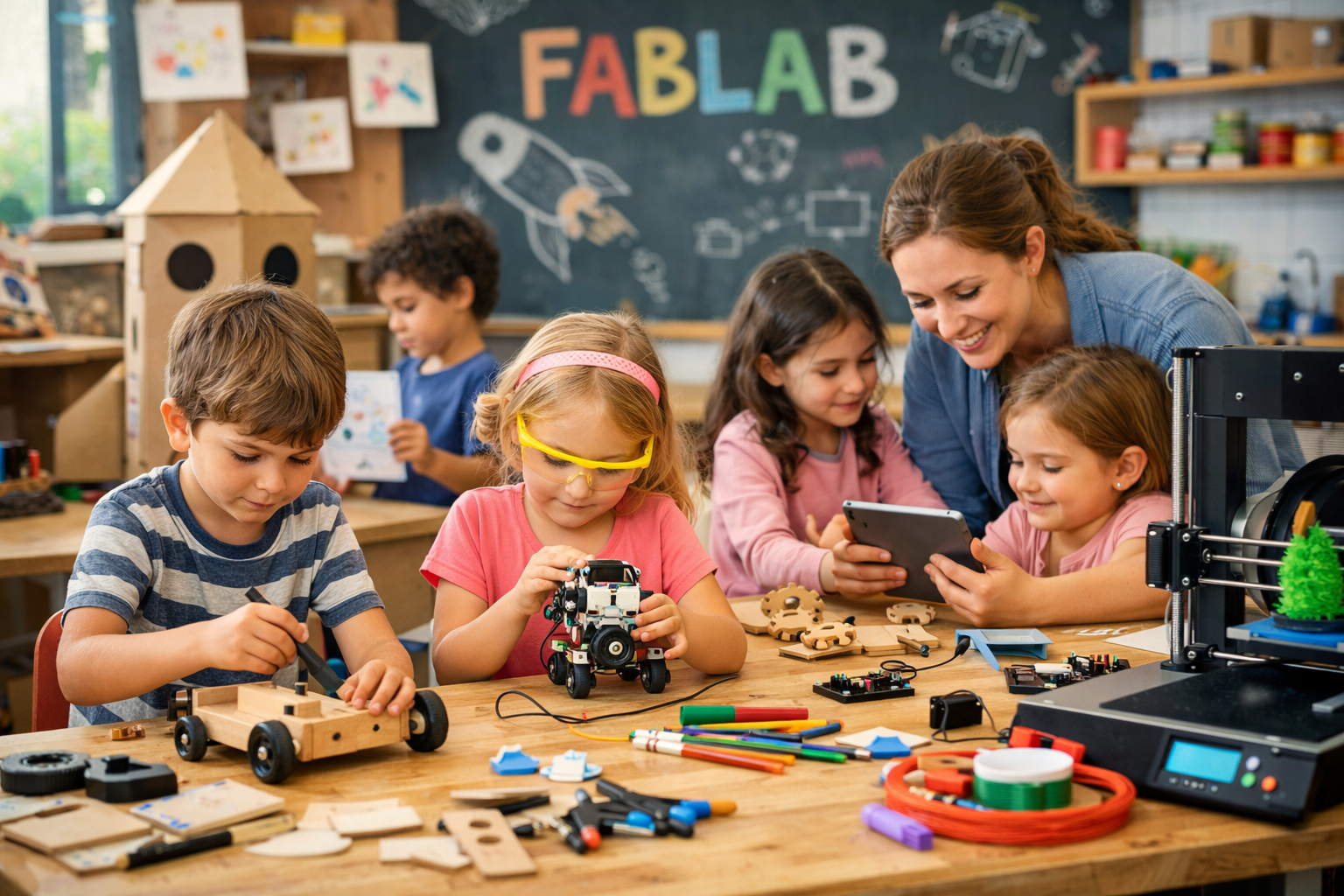
What if an innovative bilingual school offered much more than a traditional curriculum? At the heart of our international preschool and elementary school, the fablab becomes a real driving force for learning: a space where children explore science, technology, creativity, and collaboration through hands-on projects. Designed to support each student on their path to success, this environment promotes self-confidence, independence, and a forward-looking educational approach at a private bilingual school in Essonne that prepares children for tomorrow's world.


What if schools no longer just taught children how the world works, but actually gave them the means to build it?
Today, many parents feel a disconnect between the school they attended and the world their children are growing up in. Jobs are changing, technology is transforming our habits, and creativity is becoming an essential skill. Yet in many schools, learning remains highly theoretical, sometimes disconnected from reality. It is precisely to meet this challenge that a fablab has its place at the heart of a preschool and elementary school.
A fablab is not a room filled with impressive machines. It is above all a state of mind. A space where children can imagine, create, test, make mistakes, start again, and above all understand that their ideas have value. In a school focused on the future, the fablab becomes a natural extension of teaching: a place where knowledge comes to life.
From kindergarten onwards, children learn by doing. They build, assemble, and experiment spontaneously. This need to explore is an incredible force. In a fablab adapted to their age, this curiosity becomes a driving force for learning. Children discover shapes, volumes, and simple mechanisms. They develop their fine motor skills and their ability to observe and reflect. They understand that creating requires time, patience, and perseverance. These are essential skills that extend far beyond the early years of school.
In elementary school, the fablab opens up an even wider field. Mathematics ceases to be abstract when a student has to measure in order to build an object or adjust a project. Science becomes concrete when students explore reactions, materials, or educational robotics. Even languages take on a lively dimension: explaining a project, collaborating with a classmate, or presenting a creation naturally develops oral expression and self-confidence.
For parents, the benefits are clear. Children who understand why they are learning are more engaged. They no longer work simply to follow instructions, but to bring an idea to life. This deep motivation changes their relationship with school. It fosters independence, perseverance, and a love of learning.
In a fablab, every child can find their place. Some like to think long and hard before acting. Others need to manipulate things to understand them. Some prefer to work in groups, while others work better alone before sharing their ideas. This diversity is a source of richness. It allows for a variety of profiles, including those who may feel out of place in a more traditional setting. Inclusion is not just a theoretical concept: it becomes a reality experienced on a daily basis.
Contrary to popular belief, integrating a fablab into schools does not mean multiplying screens or artificially accelerating learning. On the contrary, it is about restoring meaning to action, creation, and collaboration. Children work together, exchange ideas, learn to listen, and respect each other's pace. They discover that collective success is often richer than individual success.
A fablab also helps develop a genuine scientific culture from an early age. In a world of constant innovation, understanding how objects and technologies work is becoming essential. Children are not just users: they become explorers. They learn to ask questions, seek solutions, and consider several possible paths to achieve a goal.
For a family, choosing a school that incorporates a fablab means choosing a stimulating environment that is consistent with the challenges of tomorrow. The fundamentals remain at the heart of the school curriculum. Reading, writing, arithmetic, and structured thinking are essential. But these skills take on a new dimension when they are applied to concrete projects. Children don't just memorize knowledge: they learn how to use it.
The fablab also plays an important role in developing self-confidence. Seeing an idea turn into a real object provides deep satisfaction. Children become aware of their abilities. They discover that they can imagine, build, and share. This confidence then feeds into all other learning, both academic and personal.
Beyond students, the fablab can become a real meeting place for the educational community. Parent-child workshops, collaborative projects, and opportunities for discussion help to create a strong bond between the school and families. The school is no longer just a place of learning: it becomes a space for living, innovating, and sharing.
In a modern preschool and elementary school, the fablab embodies a clear vision: to prepare children not only to succeed today, but to evolve with confidence in tomorrow's world. It encourages creativity without neglecting rigor, autonomy without abandoning support, and innovation without losing sight of the essentials.
Choosing a school that offers a fablab means providing your child with an environment where curiosity is valued, experimentation is encouraged, and every student can develop their talents. It means helping them understand that learning is not limited to exercises on a piece of paper, but that they can turn their ideas into reality.
Because today's children will be tomorrow's creators, providing them with a space to imagine, build, and explore is not a luxury. It is a necessity. The fablab then becomes much more than a room dedicated to manufacturing: it is the symbol of a lively, ambitious, and deeply forward-looking school.
27 rue Jean Rostand
91400 ORSAY
+33 (0) 1 59 04 11 94
contact@314internationalschool.fr