Does your child already speak Chinese?
Let's help them develop their language skills.
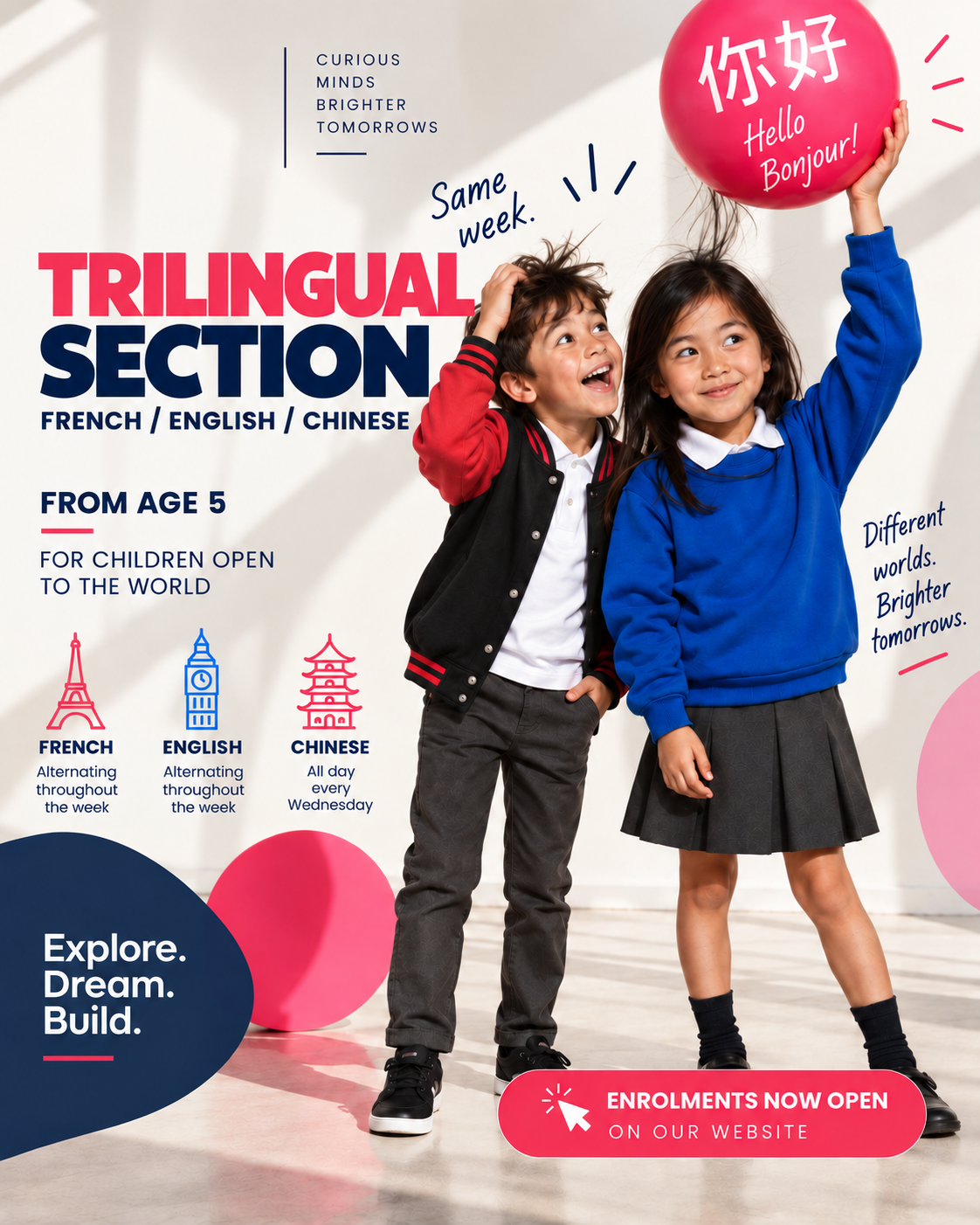
Do they speak Chinese at home or already have a basic grasp of spoken Chinese? Starting at age 5, the trilingual program at 314 International School helps them enrich their language skills, learn to read and write in Chinese, and explore Chinese culture and literature. All as part of a curriculum that includes French, English, and Chinese.
From spoken Chinese to read, written, and shared Chinese
Your child understands conversations in Chinese, communicates with family and friends, or is beginning to express themselves in this language. These skills are a valuable starting point. But oral fluency isn’t always enough to recognize characters, read a story, or write their own words.
The trilingual program at 314 provides a framework for developing the Chinese language skills already present in a child’s life into academic proficiency. The goal is to build on what is taught at home or what has already been learned, and to give the child the tools to take their skills to the next level.
Four Ways to Improve Your Chinese
Depending on their age, background, and skill level, each child gradually develops four complementary areas: oral expression, reading, writing, and culture and literature.
A foundation in speaking, and a whole progression to build
Speaking Chinese at home, understanding without yet speaking much, or having acquired some basic speaking skills: everyone’s journey is different. The key is to build on what the child already knows, to expand their vocabulary, refine their expression, and gradually develop their relationship with the written language.
Growing Up with All Your Languages
For a child who speaks Chinese at home but interacts primarily in French and English at school, reconnecting with their family language in the school setting can be particularly important.
Their language is no longer just the language of home: it also becomes a language of knowledge, reading, writing, culture, and learning.
It is this continuity between family and school that we hope to foster at 314: to enable children to fully develop their various languages and to view each one as a valuable asset.
Chinese Thrives in a Trilingual Education Program
At 314 International School, learning a language isn’t just about attending a few hours of class each week. A language truly comes alive when it is used to think, discover, create, play, work, and communicate.
Our new trilingual program is based on this approach. The children learn in an environment where French, English, and Chinese each have their place in their weekly curriculum.
French
A language of instruction and communication used in learning, projects, and everyday life at school.
English
English is truly a language of instruction, used naturally in learning, discussions, and projects.
Chinese · Chinese
Every Wednesday, students in the trilingual program learn in Chinese all day long.
A Truly Trilingual Week
MONDAY THROUGH FRIDAY
French and English are used alternately throughout the week.
WEDNESDAY
A full day of Chinese, with lessons
tailored to each child's language level.
Starting at age 5, build on early learning
Childhood is a particularly favorable time for the development of language skills. Regular exposure to multiple languages gradually enables children to refine their listening skills, pronunciation, comprehension, and ability to switch between different linguistic environments.
Our goal, therefore, is not to compile lists of vocabulary, but to build a natural, positive, and lasting relationship with each of the three languages.
You can't learn a language just from a textbook.
You have to experience it.
Three languages… and so much more
The 314 Approach
This section is fully aligned with the educational mission of 314 International School – Paris-Saclay: to offer children a challenging, dynamic, and forward-thinking international school, where languages are not separated from the rest of the curriculum.
Science, projects, creativity, culture, and collaboration become opportunities to give meaning to languages.
Because preparing children for the world of tomorrow also means giving them the tools to understand, communicate, and collaborate with people who do not speak, think, or write exactly as they do.
His Chinese already has a history.
Let's write the next chapter.
Does your child speak Chinese at home
or already have a basic grasp of spoken Chinese?
Discover a program designed to develop
all aspects of your child’s language skills.
French. English.
Chinese.
314 International School – Paris-Saclay.