Choosing a school for a 2-, 4-, or 8-year-old is a bet on the future. A bet on who they will be at age 20. What kind of adult they will become. What doors will open for them. What inner resources they will have to navigate a world we cannot yet describe exactly. Here, in concrete terms, is what we are building, and what we see taking shape in children who grow up in this kind of environment.
This isn’t just abstract speculation. It’s what research in education, neuroscience, and child development has consistently shown us over the past twenty years. And it’s what we, as teachers in international schools, have observed firsthand, year after year.
We don’t prepare our students
for a career. We prepare them
to create their own.
Six portraits of the same child
Student 314 is not a one-dimensional person. He is all of these things at once, depending on the day, the situation, and the challenges he faces.
He thinks in two languages.
He lives in two cultures.
At age 20, your child doesn’t “speak English” as a skill—they think in English. They sometimes dream in English. They choose which language to use based on how they feel, who they’re talking to, and the context. It’s not translation—it’s a natural fluency that has been developing since they were 2 years old.
This dual linguistic background opens doors that others do not yet see. The most selective universities, the most ambitious companies, the most international projects: all of these are accessible to them without barriers. But beyond pragmatism, there is something deeper: a child who is bilingual from an early age develops an ability to understand others, to see the world from multiple perspectives, which permanently changes the way they relate to people and ideas.
When faced with a problem,
he comes up with a solution.
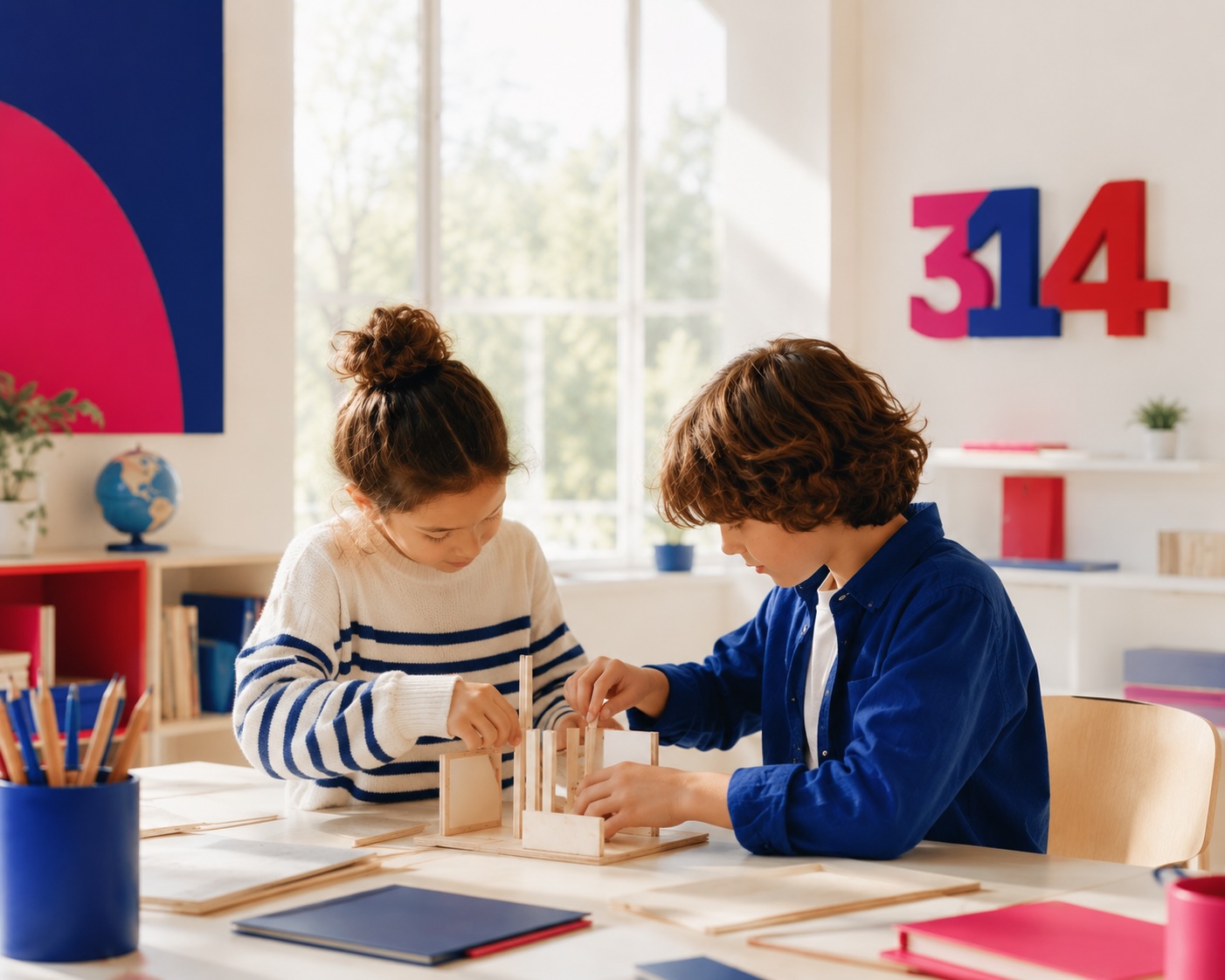
Starting in kindergarten, your child has learned something that many adults have never fully grasped: an idea can become a reality. They’ve drawn an object, modeled it, printed it, and held it in their hands. They’ve made mistakes, started over, and improved upon their work. This cycle—designing, building, testing, and improving—is ingrained in their way of thinking.
At age 20, when faced with a complex challenge, his first instinct isn’t to wait or get discouraged. It’s to ask, “How do I come up with a solution?” This is what’s known as an engineer’s mindset, and it’s one of the most sought-after skills across all industries, far beyond the tech sector.
He doesn't believe everything he reads.
He asks questions. He checks things out. He thinks for himself.
Inquiry-based learning—the question-driven teaching approach we use at 314—shapes minds that know how to ask the right questions before seeking answers. In an age of information overload and often contradictory information, this is an essential intellectual skill.
Your 20-year-old child is not someone who passively accepts what they’re told. They dig deeper. They compare sources. They know how to distinguish an opinion from a fact, a hypothesis from a certainty. They also know how to change their mind when the evidence calls for it—which is, ultimately, the rarest sign of a well-developed intellect.
Math doesn't scare her.
It speaks to her.
The Singapore Math method has achieved something rare: a child who has a calm and confident relationship with mathematics. Not because they have memorized formulas, but because they have understood, from the very beginning, why they work.
At 20, he has no trouble with quantitative subjects. Statistics, probability, and logic are tools he handles with ease, whether for scientific, economic, or even literary studies. But beyond math itself, it is the rigorous reasoning he has developed that serves him well in every situation: in an argument, in an analysis, or in a complex decision.
He's curious about other people.
Really curious.
Growing up in a bilingual international school means growing up surrounded by children from different cultures, with different languages, and from different backgrounds. It means learning, from a very young age, that the world is not just your neighborhood, and that this diversity is a source of richness, not a threat.
At age 20, your child is someone who reaches out to others. Someone who listens before judging. Someone who knows how to adapt their tone depending on who they’re talking to. Someone who sees differences as a source of curiosity rather than discomfort. In an increasingly polarized world, this openness is a rare and crucial skill, both in personal and professional relationships.
He knows who he is.
And that changes everything.
This may be the most profound transformation—and the least visible from the outside. A child who has grown up in an environment where they were seen, heard, and supported as an individual develops something irreplaceable: a stable sense of self-confidence that does not depend on constant validation from others.
He learned to make mistakes without falling apart, because at 314, making mistakes was a normal part of the process. He learned to stand up for his ideas, because his ideas were always taken seriously. He learned to ask for help, because asking for help was never seen as a weakness.
At 20, this inner strength allows her to take risks. To take the initiative. To start over after a setback. To define herself not by her results, but by her journey. Ultimately, that is what the world needs most.
It is not a high-achieving student
that we want to educate.
It is a well-rounded human being.
These remarkable adults
start at age 2.
The six profiles we have just outlined are not abstract promises. They are the direct result of specific educational choices made from the very first day of school and consistently upheld over the course of nine years.
Natural bilingualism begins at age 2, when the brain is at its most plastic. Creative thinking develops starting in kindergarten, with every session at the FabLab. Critical thinking takes root through each inquiry-based project. Self-confidence is built through every interaction with an adult who takes the child seriously.
None of these effects happen overnight. They all develop slowly, steadily, and imperceptibly, and only become apparent much later. This is precisely why choosing a school at a young age is so crucial: the seeds planted now will become the trees of tomorrow.
That is also why 314 will not stop at fifth grade. Opening a 314 middle school is part of our roadmap. This ensures complete educational continuity—the same bilingual environment, the same rigor, and the same spirit—all the way through to high school. Because shaping well-rounded individuals is a long-term endeavor, and we want to be there every step of the way.
Academic and personal excellence. Both, without compromise.
At 314, we strive for excellence—academic, personal, and creative. We promise that your child will enter adolescence with a solid academic foundation, true bilingual proficiency, and a clear sense of their own capabilities. A child who enters adulthood equipped with the tools to build their own life, in the language of their choice, with the people they’ve chosen, and in a field that suits them.
The future starts now
.
Come meet our founding team and learn how 314 is shaping the adults of tomorrow, starting today.