Education · Curriculum · STEM
Math,
isn't something you just recite —
it's something you think about.
At 314 International School, math and science are not just subjects among many others. They are the language of the school—the language that connects the concrete to the abstract, the question to the solution, and the child to the world.
Singapore, the world leader in mathematics for the past 30 years
The age at which logical reasoning begins in our students
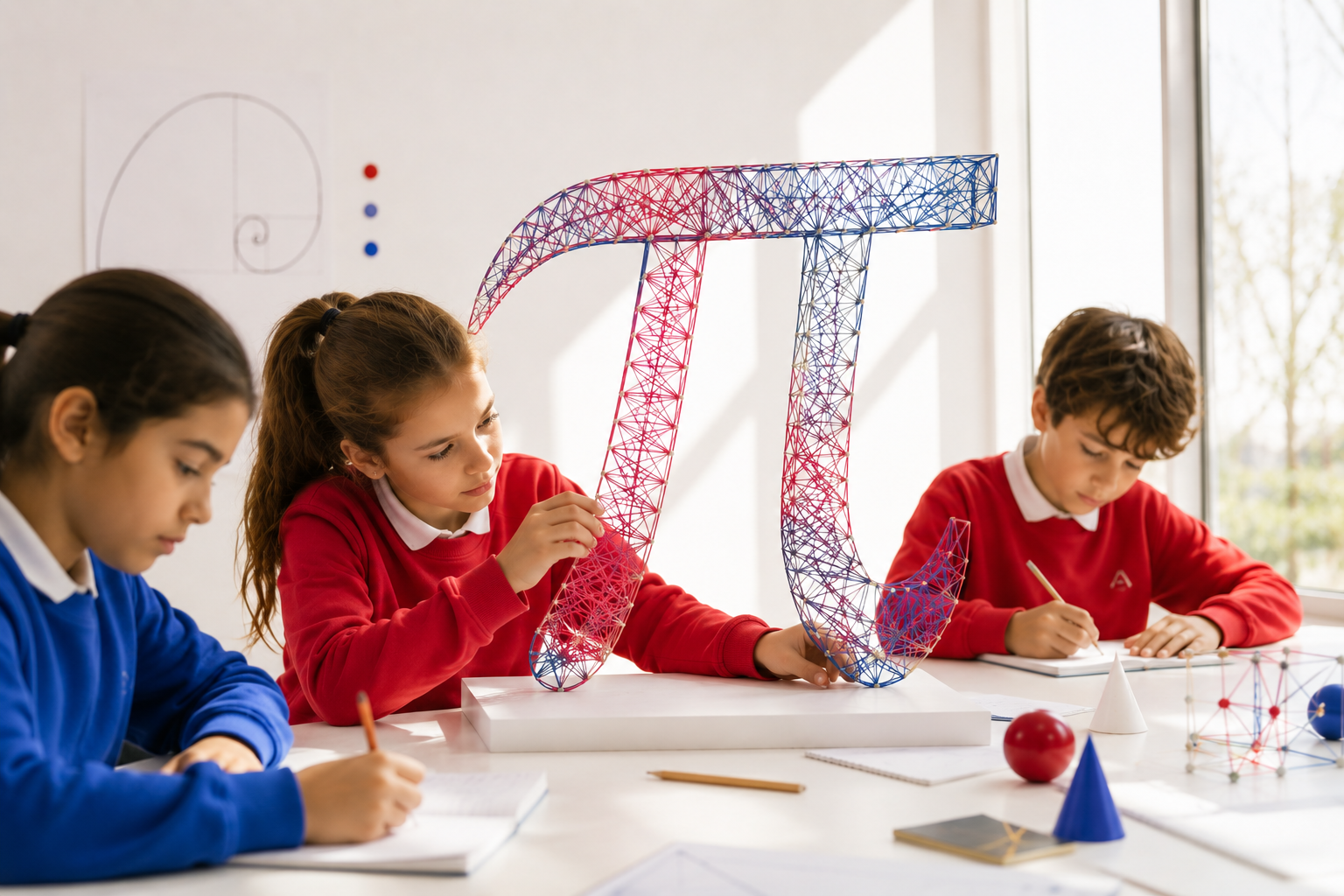
The school's name—a tribute to π, the most beautiful constant in mathematics
A school called π is no ordinary school.
When we chose to name our school 314, it wasn’t a coincidence or a marketing gimmick. It was an educational statement. π is infinite, irrational, and yet it governs circles, spirals, waves—everything that is alive and in motion. That is exactly how we view mathematics for our students: a tool for understanding the world, not a series of formulas to memorize.
We welcome children ages 2 to 12 on the Saclay Plateau in Orsay—one of Europe’s most concentrated scientific hubs. This isn’t just a geographical detail; it’s a responsibility. Our students grow up surrounded by researchers, engineers, and state-of-the-art laboratories. We must give them the foundation they need so that, one day, we can speak with them as equals.
The goal isn't to train little mathematicians. It's to help children learn to think through unfamiliar situations —and that starts as early as preschool.
The method that changed everything.
In 1981, Singapore completely overhauled its mathematics curriculum. Forty years later, Singaporean students consistently top the TIMSS and PISA international rankings—a track record that has ultimately won over education systems around the world. France, the United Kingdom, the United States, and Denmark have all adopted it or drawn heavily on it. At 314, it is the backbone of our mathematics education.
What fundamentally sets this approach apart from traditional methods is the refusal to rush through the steps. Before writing a number, the child touches it. Before writing an addition problem, the child visualizes it. And before thinking abstractly, the child understands.
We handle real objects: cubes, tokens, and small sticks. The concept exists in our hands before it exists in our minds.
We draw what we've been working with. The famous bar models —diagrams made up of bars that make complex problems suddenly easy to understand.
Only then do the symbols, the equations, and the formal notation come into play. But this is based on a genuine understanding, not on rote memorization.
In-depth mastery rather than a superficial overview: a single, well-understood concept is better than five concepts only touched upon. That’s why at 314, we take our time. We go back when necessary. We move forward together, and we move forward steadily.
And what about our bilingual children?
French-English bilingual immersion adds an extra dimension to mathematics learning. Thinking in two languages means thinking through two different frameworks. Research in neurolinguistics is clear: bilingual children develop cognitive flexibility that directly translates into problem-solving skills. At 314, math in English and French are not two separate courses—it is the same way of thinking, enriched.
Children are natural scientists. We let them be.
Every 3-year-old is already a scientist. They form hypotheses (“What if I put this there?”), they experiment (“Let’s see what happens…”), and they analyze (“Aha—it flows!”). The problem is that traditional schools tend to replace this natural process with the transmission of fixed knowledge. Answers are taught before the questions have even been asked.
At 314, we do the opposite. The question always comes before the answer. Whether it’s understanding how plants produce energy, why water boils, or what holds a bridge together, our students first observe, then formulate a hypothesis, and always verify their findings.
A child who understands why iron rusts will always be further along than a child who has simply been taught that iron rusts. That is the difference between science that is memorized and science that is understood.
Observe
Develop keen senses. Learn to describe things accurately. Observation is the first scientific skill—and the most underrated one.
Question
Formulating a hypothesis is already a form of reasoning. We value good questions just as much as good answers—sometimes even more.
Experiment
Making mistakes is part of the process. Every mistake is a piece of data. The important thing is knowing what to do with it.
This approach spans all scientific disciplines—from the life sciences to physics, from Earth sciences to astronomy—but also, deeply, mathematics. Here, the boundaries between “doing math” and “doing science” are intentionally blurred. Logical thinking is one and the same.
When the abstract becomes real, it becomes unforgettable.
The 314 FabLab isn't just a tech playground. It's a fabrication lab integrated into the curriculum—a place where mathematical and scientific concepts leave the pages of textbooks and come to life in the physical world.
Calculating the dimensions of a part for a 3D printer is mathematics. Understanding why a laser cuts a particular material at a certain power is physics. Programming a robot to move so that it traces a square with 10-cm sides is geometry brought to life. At the FabLab, fractions are no longer abstract—they’re engraved in wood.
Projects as a Driver of Learning
Each FabLab session revolves around a meaningful project: designing a miniature irrigation system, building a musical instrument, or constructing a scale architectural model. This isn’t just craftsmanship—it’s engineering thinking. And this way of thinking—breaking down a complex problem, testing, adjusting, and refining—is precisely what the world expects from the generation we’re educating.
Our students have access to a comprehensive robotics lab, professional 3D printers, laser cutting equipment, and an electronics prototyping environment tailored to each grade level. Starting in Cycle 1, children tinker, program, and build—using their hands, their minds, and their pride.
Background
Orsay isn't just
an ordinary website.
It's an ecosystem.
The Saclay Plateau is one of the most densely concentrated scientific clusters in Europe. Our students grow up near the University of Paris-Saclay, the CNRS, the CEA, École Polytechnique, and CentraleSupélec. This proximity is a unique opportunity: it fuels their ambitions, grounds their learning in tangible reality, and reminds them every day that science isn’t just in books—it’s done by people, in laboratories, not far from here.
What we promise every student.
When a child leaves 314 at the end of fifth grade, we want them to take three things with them: the certainty that they know how to reason, the confidence to face new problems without fear, and the curiosity that makes everything else possible.
Math and science are the training ground for these three skills. They teach students to persevere when they encounter obstacles, to explore different approaches, and to set aside one strategy to try another. These are life skills—not just skills for a test.
A school called π knows one thing: numbers never lie, and neither do children. You just have to ask them the right questions.
Come meet the team.
314 International School will open in Orsay in September 2026. Schedule a visit and see our curriculum in action.
Contact us →