Science and math starting in preschool: where it all really begins
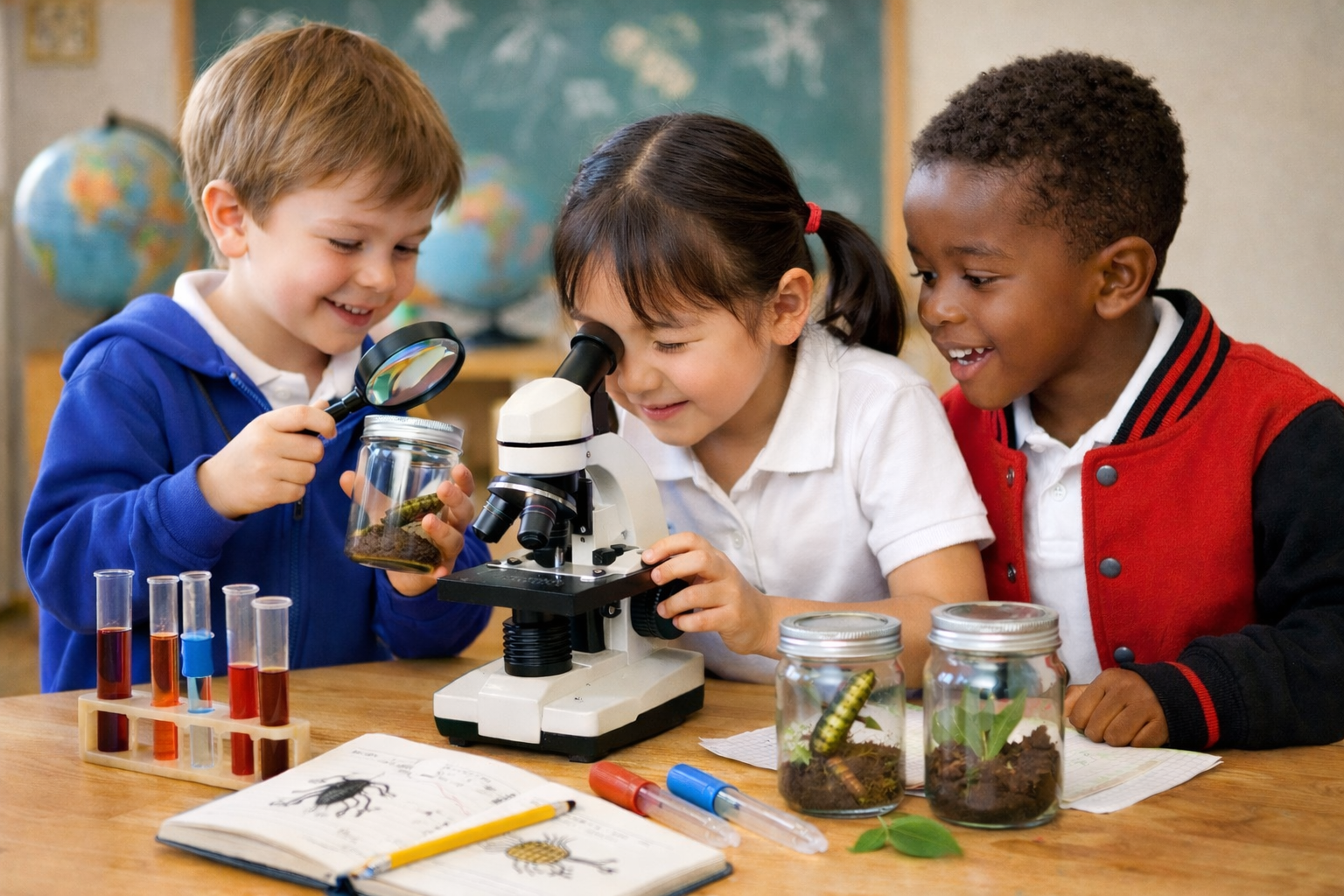
Observe, explore, experiment… both in the classroom and in nature. Thanks to our garden, our vegetable patch, and our wooded surroundings, children experience science and math every day, in settings where these subjects truly come to life.
Math and Science in Preschool: Much More Than Just Counting to 10
People often think that preschool is all about learning to count, reciting nursery rhymes, recognizing a few shapes… and waiting for “the real stuff.” As if math and science didn’t start until later, once the child is “ready.”
It’s a comforting notion. But it’s fundamentally wrong.
Because, in reality, a 3-, 4-, or 5-year-old is already an outstanding scientific explorer. They observe, test, compare, and adjust. They don’t just learn—they seek to understand. And it is precisely at this age that everything comes into play.
In kindergarten, math isn't a rigid subject. It's everywhere.
They are present in building activities, when a child stacks, balances, and adjusts things so that “it holds together.” They are present in sorting games, when a child classifies, categorizes, and organizes the world around them. They are present in routines, when a child understands the order, repetition, and logic of daily life.
Counting is just a starting point. What really interests us is what lies behind it: the concepts of quantity, comparison, and structure.
Why is this group “bigger”? How can I make it “the same size”? What happens if I add one? Or if I take one away?
It is these kinds of questions that build a solid foundation in mathematical thinking.
What about the sciences?
They begin long before the spectacular experiments.
They are born in a puddle of water, when a child notices that “it disappears.” In a seed that sprouts. In a shadow that shifts. In an object that floats… or doesn’t.
At this age, studying science isn't about learning the answers. It's about learning to ask questions.
Why?
How?
What will happen if…?
Above all, these questions don't stay confined to the classroom.
They continue outside.
In the garden, children observe the seasons, the growth of plants, and the changes in living things. In the vegetable garden, they gain a hands-on understanding of what it means to plant, wait, water, and harvest. Time becomes visible. Patience becomes an experience.
In our wooded environment, they explore, compare, and collect. Why are some leaves different? Why is the ground damp here and dry over there? Why do certain insects appear at certain times?
Nature becomes a veritable open-air laboratory.
And suddenly, math and science stop being abstract.
Measuring a sprout, comparing sizes, counting seeds, noticing patterns… it all makes sense, because it’s all part of the experience.
It might be tempting to “simplify” things to make them more accessible. In reality, we need to do exactly the opposite.
We need to add more.
Encourage children to explore, experiment, make mistakes, and try again. Give them materials, time, and space—both indoors and outdoors.
Because even when a Kapla tower collapses, there’s physics at work.
There’s already a certain logic to sorting through leaves gathered from the garden.
Behind every seed that’s planted lies biology.
At 314 International School, we don’t just do “a little math” or “a little science.”
We build minds that think.
Children who are able to observe the world, ask questions, and make connections. Children who understand because they have experienced it for themselves.
Because understanding is infinitely more powerful than knowing.
And because the children who are learning to think today are the ones who, tomorrow, will not be content to simply go along with the world as it is…
…but who will have the tools to transform it.
27 rue Jean Rostand
91400 ORSAY
+33 (0) 1 59 04 11 94
contact@314internationalschool.fr