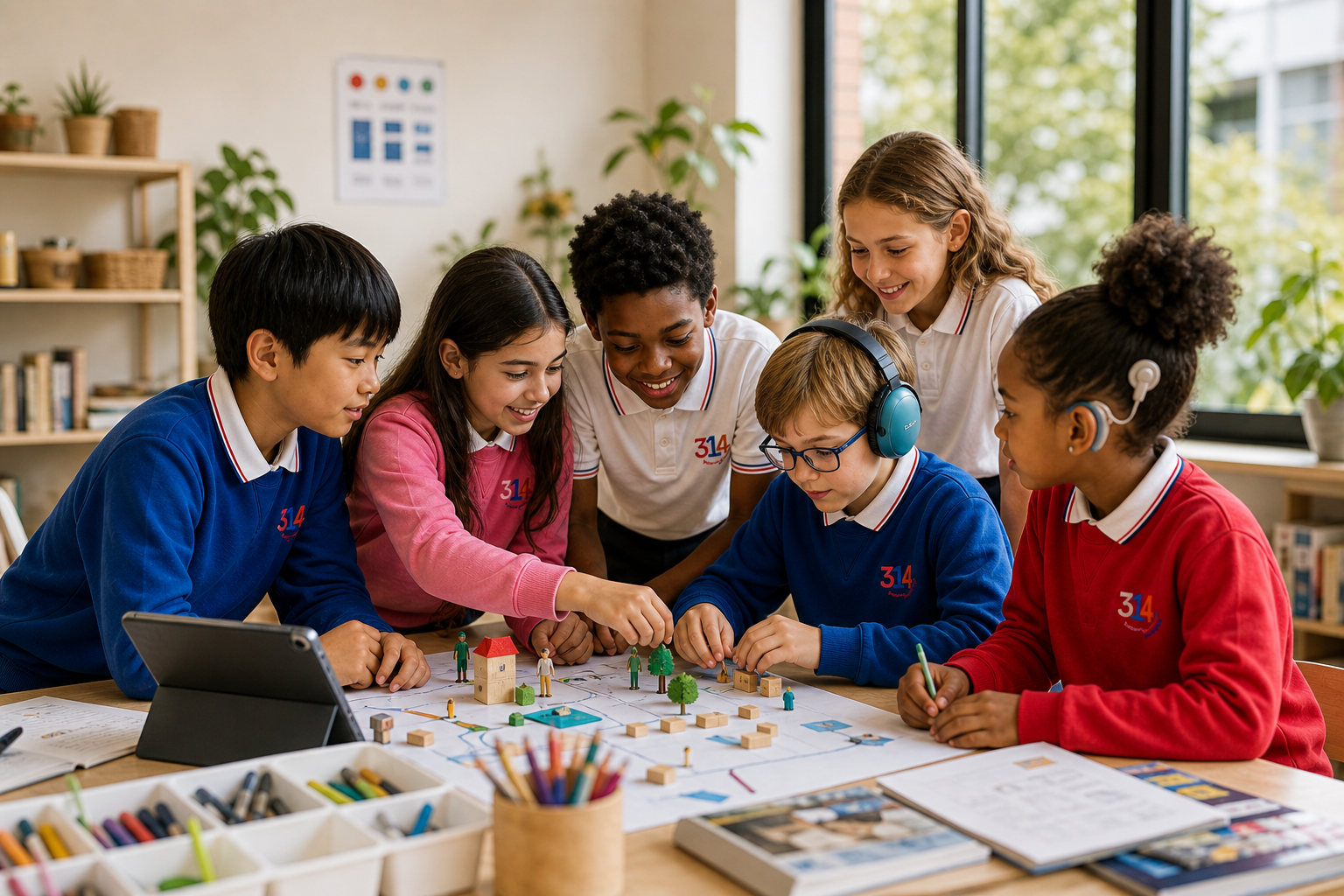
In many schools, “inclusion” is just a buzzword in the school’s mission statement. Here, it’s part of our daily practice. We don’t believe in a one-size-fits-all approach. We believe in tailored pathways for each student—with the same high standards for everyone.
See each child for who they are
A child with dyslexia is not a child with learning difficulties. It is a child whose brain works differently. A gifted child is not a child who is “ahead of the curve.” It is a child who needs to be nurtured differently. A child who arrives without speaking French is not a child who is “behind.” It is a child who already carries within them the richness of another language, of another culture.
At 314, we refuse to reduce a child to a label, a diagnosis, or a score. Our starting point is always the same question: Who is this child? What are they passionate about? How do they learn best? What do they need to reach their full potential?
Inclusion isn't about forcing everyone into the same mold. It's about breaking the mold—and creating as many paths as there are children.
— 314 International SchoolThis belief is based on a simple fact: in classes of no more than 18 students, with a ratio of one adult to every six children in preschool, we have the time to get to know each child. Not as a name on a list, but as a person. And it is this personal connection that makes personalized care possible.
Special educational needs: a protocol, not an exception
Dyslexia, dyspraxia, ADHD, language disorders, and high intellectual potential: these conditions are not rare. In a regular classroom, many children have specific educational needs—often without these having been identified yet. At our school, the attention we give to each student allows us to identify, understand, and take action.
-
Observation and Early Identification Our teachers are trained to identify the signs—a child who avoids writing, who loses their train of thought, who compensates brilliantly. The earlier we identify the issue, the more effectively we can intervene.
-
Personalized Support Plans (PAP, PAI) When a need is identified, we implement a Personalized Support Plan or an Individualized Care Plan, in close collaboration with families and healthcare professionals. Each protocol is unique, because every child is.
-
Coordination with outside specialists Speech-language pathologists, psychomotor therapists, neuropsychologists, occupational therapists: we work closely with the professionals who support the child outside of school to ensure a consistent approach.
-
Differentiated Instruction in Everyday Teaching Beyond formal protocols, every teacher naturally adapts their materials, instructions, and pace. Differentiation is not a one-off measure—it is simply how we teach.
Inclusion also applies to children with physical disabilities. Accessibility of the facilities, adapted furniture, and adjustments to travel times and physical activities: we design the environment so that every child can fully participate in classroom life, regardless of their physical abilities. A child in a wheelchair must be able to access the FabLab, participate in a field trip, and be at the heart of a group project—not on the sidelines.
A child enrolled in a PAP does not follow a separate program. They follow the same curriculum, with the same academic goals, but with the necessary accommodations to ensure full participation. Extra time, adapted materials, rephrased instructions, and specialized tools: these adjustments are subtle, effective, and integrated into the daily life of the classroom.
Why size matters
In a class of 30 students, a child with a learning disability can go unnoticed for months. In a class of no more than 18 students, with enhanced support, this is structurally impossible. Our teachers know each child by name AND by their learning style. It is this close relationship that makes inclusion a reality— not just a theory.
Speaking another language isn't a setback. It's a treasure.
In an international school, children arrive with a variety of language backgrounds. Some speak French but not English. Others speak English but not French. Still others arrive speaking a third language—Arabic, Mandarin, Japanese, Portuguese—and learn both of the school’s languages at the same time.
At 314, everyone is welcome, regardless of their background. And everyone receives structured support to learn the school’s two languages at their own pace.
Our immersion programs are designed to help every child achieve a functional level of proficiency in their target language within a few months—without pressure, but with a structured approach. The approach is intensive, supportive, and integrated into classroom life: children are not isolated; they learn by interacting with their peers.
A child who arrives speaking Japanese and begins learning French at age 4 isn't starting from scratch. They're starting with a fully developed language. That's a tremendous asset—and we treat it as such.
— 314 International SchoolNeuroscience research is clear: early bilingualism and multilingualism enhance cognitive flexibility, working memory, and the ability to adapt. A child who switches between multiple languages develops transferable skills that benefit all areas of learning. It is not a disadvantage that needs to be compensated for—it is an asset to be nurtured.
Cultural diversity as an educational asset
At 314, the children come from French, expatriate, dual-national, and international families. This diversity isn't just something to manage—it's an extraordinary educational resource.
In a classroom where multiple cultures coexist, children naturally learn to broaden their perspectives, to question what seems "obvious" to them, and to take an interest in others. Inquiry-based and project-based learning, at the heart of our educational approach, is greatly enriched when perspectives are diverse. A project on food becomes exciting when one child brings recipes from their Japanese grandmother and another shares Moroccan culinary traditions.
Interculturality in Everyday Life
We don’t reduce cultural diversity to a “Cultural Day” just once a year. It is woven into our daily lives: in the books at the library (in French and English, by authors from around the world), in class projects, in discussions, and in celebrations. The children grow up knowing that the world is vast and rich, and that every culture has something unique to offer.
High standards and kindness are not mutually exclusive
Adapting a learning path doesn’t mean lowering expectations. It’s exactly the opposite. When a child is given the tools they need—the right accommodations, the right support, and the right pace—they can reach a level they would never have achieved in a system that ignores them or forces them into an ill-fitting mold.
A child with dyslexia who learns to read with the right tools becomes a reader. A gifted child whose curiosity is nurtured to its fullest potential becomes a researcher. A child who arrives without speaking French and who, six months later, gives a presentation in two languages becomes a global citizen. We do not level down. We raise every child to the height of their potential—whatever that may be.
Tailoring the path doesn't mean lowering the bar. It means ensuring that every child has a real chance of getting there.
— 314 International SchoolFamilies are at the heart of this approach. Every protocol, every adjustment, and every observation is shared and developed in collaboration with parents. Inclusion works only if the school and home work together, sharing the same perspective on the child: a perspective that is demanding, caring, and deeply respectful of who they are.
What we promise
We don’t promise to solve everything. We promise to see everything. To take everything seriously. And to work together with families and professionals to do everything in our power to ensure that every child makes progress, thrives, and feels fully at home.
Your child is unique. Their school should be, too.
314 International School — Orsay, September 2026. Explore. Dream. Build.