Every year, thousands of families go through the same transition: their child leaves a preschool where they thrived, to join an elementary school they don’t know, with new surroundings, new adults, and sometimes a completely different educational approach. At 314 International School, we’ve chosen to eliminate this transition.
A seamless educational journey, from age 2 to 12
Educational continuity is not just a marketing gimmick. It is a fundamental principle of educational science: a child learns best when growing up in a stable environment, surrounded by adults who understand their background, their strengths, and the way they learn. This is exactly what we offer by welcoming children from preschool through fifth grade within the same school, guided by a shared vision.
In practical terms, this means that a child who joins us at age 2 will not experience any abrupt transitions. Teachers pass on individualized progress reports from one year to the next. Our teaching methods are designed as a continuum: what is sown in the youngest class is cultivated in first grade, enriched in third grade, and fully harvested in fifth grade. The child does not have to adapt to a new system every three years—it is the system that adapts to the child’s progress.
A child who doesn't have to start over is a child who can go further.
— 314 International SchoolThis continuous program also lays a solid foundation in both languages of instruction—French and English—starting in preschool, and then systematically builds on that foundation throughout elementary school. An important clarification: at 314, it is not about learning two languages. It is about learning in two languages. French and English are not subjects—they are the vehicles for all subjects, all projects, and all discoveries.
International programs that go beyond the norm
The French curriculum provides a recognized and foundational framework, but it is only a starting point. At 314, we have designed an enriched curriculum that incorporates international best practices, with a clear goal: for every child to exceed national standards, not through pressure, but through the quality of what is offered to them.
-
Singapore Math The method that produces the best results in numeracy worldwide. A concrete → visual → abstract approach, for a deep understanding of mathematical concepts from an early age.
-
Inquiry-Based and Project-Based Learning Inspired by leading international programs (IB, Cambridge), each learning unit begins with a real-world question that students explore, test, and document—in two languages.
-
Learning in two languages—not learning two languages The distinction is fundamental. Here, French and English are not “subjects”: they are the languages in which we think, research, create, and debate on a daily basis. Both languages are living tools, not objects of study.
-
Integrated science starting in preschool Scientific exploration and the experimental approach are part of daily life from the earliest years, fostering curious, rigorous minds that are comfortable with asking questions.
The result? Children who don’t just memorize: they understand, ask questions, reason, and create. In French as well as in English. In math as well as in science. This isn’t elitism—it’s a caring ambition dedicated to every child.
Why go above and beyond the standards?
French and European curricula set a baseline—a minimum standard that every student must meet. But a baseline is not a ceiling. International comparisons (PISA, TIMSS) show that countries that invest in proven methods such as Singapore Math, inquiry-based learning, and early bilingualism achieve significantly higher results—not only in academic performance but also in self-confidence and creativity.
That is the goal we are pursuing at 314: to offer every child the best of what educational research has proven, without waiting for national curricula to incorporate these advances.
The classroom environment as a third teacher
In the Reggio Emilia educational tradition, the environment is considered the "third teacher"—after parents and educators. At 314, we take this idea seriously. The school’s physical environment is not merely a logistical detail: it is a full-fledged educational tool.
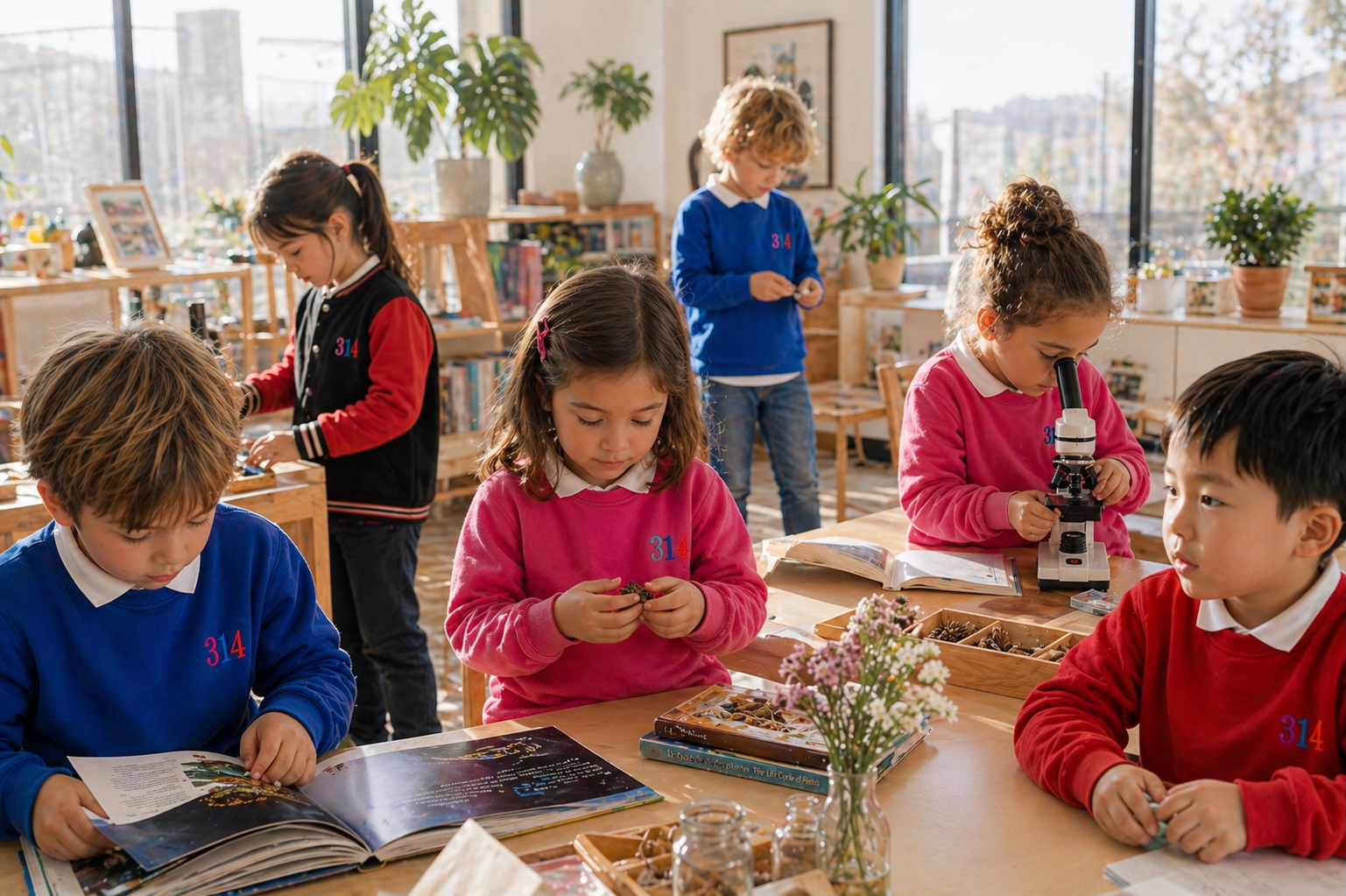
Our spaces are designed to encourage exploration, collaboration, and concentration. Flexible rooms that adapt to projects. Cozy reading corners in French and English. The Researchers’ Classroom—our dedicated science lab—where elementary students conduct real experiments, handle materials, take measurements, and formulate hypotheses. Math manipulatives aligned with the Singapore Method. Digital tools integrated naturally into the learning environment, without screen overload, but with a genuine educational purpose.
But the learning environment doesn't stop at the school walls. At 314, we also learn outside: regular field trips to museums, parks, research laboratories, and local businesses, as well as school trips that build on the projects we work on in class. A field trip is never just a break—it’s a chapter of the curriculum, experienced firsthand.
A child who learns in a beautiful environment learns that they deserve the best. That is the first message we send them.
— 314 International School314 is the only school in its district that truly dedicates the necessary human and material resources to serving the children. This is not just an empty promise: it is an exceptional teacher-to-student ratio in preschool, professional-quality educational materials, spaces designed by and for children, and a teaching staff recruited for their excellence and passion.
Natural light, ergonomic furniture tailored to each age group, outdoor spaces integrated into the curriculum, professional scientific equipment scaled for children: every detail has been carefully considered so that the space supports the learning process, not the other way around.
Families at the Heart of the School
At 314, parents don’t just drop their children off at the door and come back to pick them up in the evening. Families are an integral part of school life. We believe that a child learns best when the adults around them— both at school and at home—are moving in the same direction, with a shared understanding of their progress, challenges, and successes.
That is why communication between the school and families is ongoing and transparent. It’s not just a quarterly report card or an annual meeting, but a continuous dialogue: regular updates, sharing of current projects, direct exchanges with the teaching staff, and shared moments of school life. Parents know what their child is learning, how they are progressing, and why.
A community, not just a school
We invite families to get actively involved: open workshops, community events, contributions to class projects, and feedback. This involvement isn’t just a bonus—it’s a cornerstone of our program. When a child sees their parents and teachers working together, they understand that their education is taken seriously by all the adults in their life.
Your child deserves an educational path that matches their potential.
Opening in Orsay in September 2026 — Pre-registration is now open.
Learn about the school