In France, girls perform better than boys on the baccalaureate exam. Yet they remain a small minority in science programs and engineering schools. This paradox doesn’t just happen overnight: it builds up, year after year, stereotype after stereotype, starting in early childhood. What if the solution began in the classroom—as early as age 2?
Students start falling behind in first grade, not in high school.
It was long believed that girls "dropped out" of science in high school, when it came time to choose their courses of study. Recent data shows that this happens much earlier than that. According to the Institute for Public Policy, the gap between girls and boys in mathematics appears as early as the middle of first grade—barely five months after starting elementary school. And it continues to widen from there.
How is this possible? It’s clearly not a matter of cognitive ability. Research shows that girls perform comparably to boys in science—but that they internalize stereotypes at a very early age that steer them away from these subjects. Messages that are sometimes subtle, sometimes explicit, construct a narrative: “science is more for boys.”
And the role of schools in this process is well documented. Studies show that when a boy excels in science, he tends to be praised for his talent; when it comes to a girl, she is praised for her hard work and diligence. A difference in language that seems trivial, but which, repeated thousands of times, creates a belief: the boy is “naturally gifted,” the girl “works hard.” One has genius, the other discipline. This bias starts early—and it has lasting consequences.
The problem isn't that girls don't like science. It's that they're taught, from a very young age, to believe they don't belong there.
— 314 International SchoolWhat sets us apart at 314
If academic disengagement begins in first grade, then action must be taken before first grade. This is precisely the approach taken by 314 International School: introducing science as early as preschool, in an environment where no child—girl or boy—is influenced by stereotypes.
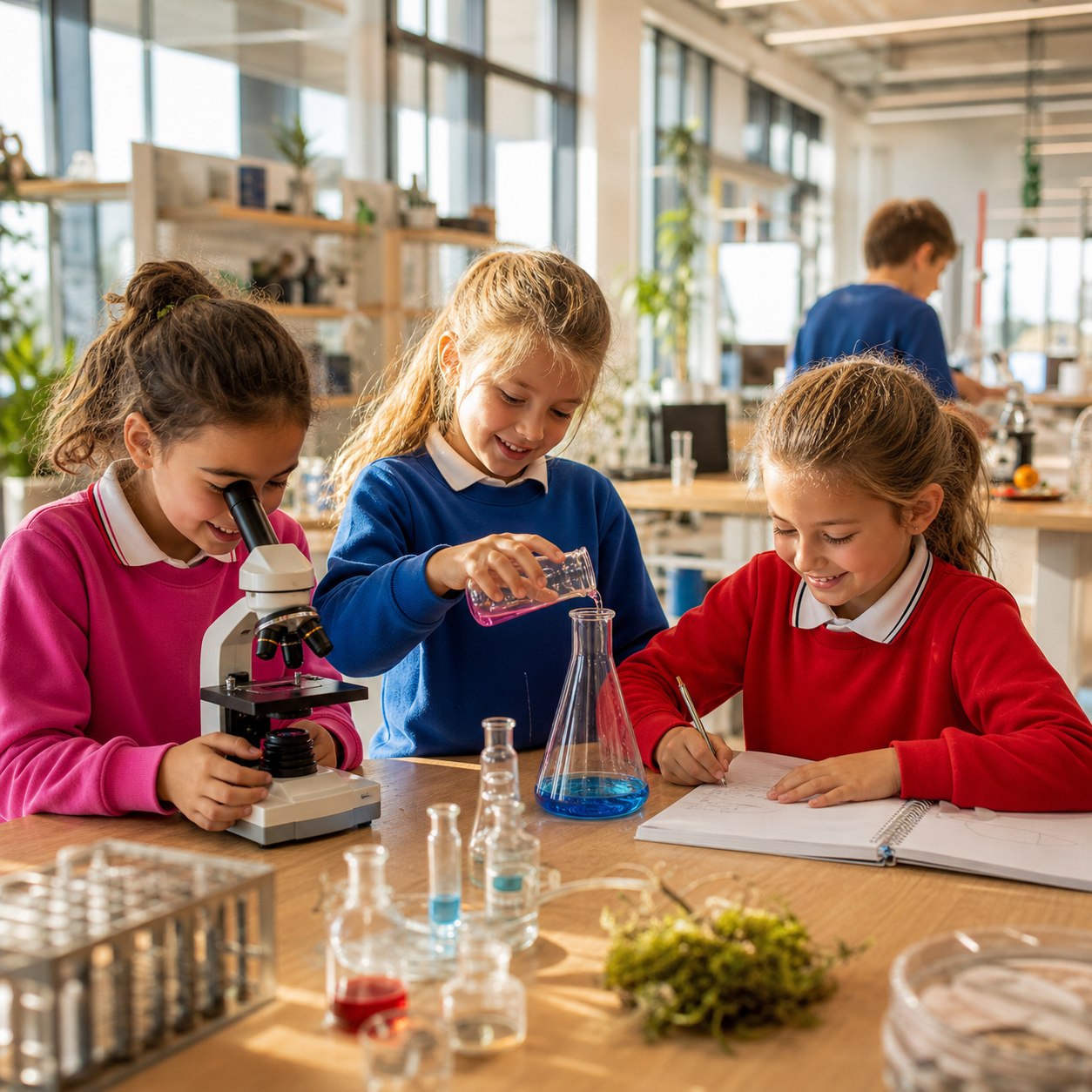
Starting in the very youngest class, our students handle objects, observe, and ask questions. They experiment with water, plants, and materials. They use magnifying glasses, scales, and measuring tools. There is no "science corner for boys" or "reading corner for girls": there is an environment where everyone explores, everyone investigates, and everyone has the right to make mistakes and try again.
As soon as they enter the Researchers’ Class—our first grade— our students gain access to the FabLab: over 100 square meters dedicated to science and technology. A real laboratory, on their level, where the scientific method comes to life. There, the children formulate hypotheses, experiment, measure, build, make mistakes, and try again. Girls have exactly the same role, the same tools, and the same expectations as boys—and that changes everything.
In this space, there are no "science corners for boys" or "arts corners for girls": there are microscopes, circuits, materials, tools—and children exploring together. Girls aren't "invited to participate": they are at the heart of the program, just like their peers.
Bilingualism as a tool for equality
Learning in two languages offers an unexpected advantage in the fight against stereotypes. International research shows that early exposure to different cultural contexts develops cognitive flexibility and reduces adherence to gender roles. At age 3, children discover that in other cultures, in other languages, women scientists are celebrated, visible, and considered normal. Bilingualism broadens role models—and horizons.
Models that are changing the narrative
You can't become what you don't see. That's why, at 314, we incorporate female scientists into the curriculum—as a matter of course, not just as a one-off event on March 8. Female scientists are part of the school's everyday landscape—in textbooks, projects, displays, and field trips.
-
Marie Curie Two-time Nobel laureate, pioneer of radioactivity. We’ll start with the basics—and explain why she had to fight twice as hard.
-
Katherine Johnson A mathematician at NASA, her calculations sent astronauts into space. Overlooked for decades—never again.
-
Emmanuelle Charpentier 2020 Nobel Prize in Chemistry for the CRISPR revolution. French, vibrant, inspiring—and featured in our science projects.
-
Sylvia Earle Oceanographer, deep-sea explorer, environmental activist. Proof that science and activism go hand in hand.
-
Ada Lovelace The first programmer in history—in the 19th century. We introduce her to our students even before they touch a keyboard.
But role models aren’t just found in books. We organize meetings with women scientists, engineers, and researchers—real people with real life stories who come to talk about their daily lives. So that a 6-year-old girl can say to herself, “She’s just like me. So I can do it, too.”
Parents: 6 Simple Steps to Make a Difference
Schools can't do it all on their own. Stereotypes are also formed at home—often without us even realizing it. Here are six practical steps you can take right now to encourage your daughter to pursue science.
Our vision: scientists first, girls and boys second
At 314 International School, we don’t have a “special program for girls.” We do something more radical: we create an environment where gender isn’t an issue in science. Where a 4-year-old girl who takes apart a mechanism isn’t “surprising”—she’s normal. Where a 5-year-old boy who cries over a failed experiment isn’t “weak”—he’s learning.
When science is integrated starting in preschool, when it is taught through inquiry and projects, when the right to make mistakes is a founding principle, when female role models are everywhere—then stereotypes simply have no hold. Children grow up with one certainty: curiosity has no gender.
We don't want our students to become girls who study science. We want them to become scientists—period.
— 314 International SchoolMost girls are looking to find meaning in their educational path—they are drawn to paths that offer engagement and impact. This is exactly what our project-based learning offers them: science connected to the real world, questions that matter, and experiences that help them understand and take action. Not abstract, disconnected science—living science.
Curiosity knows no gender. Neither does ambition.
314 International School will open in Orsay in September 2026. Science classes starting in preschool, Research Class, FabLab, bilingual education.
Learn about the school